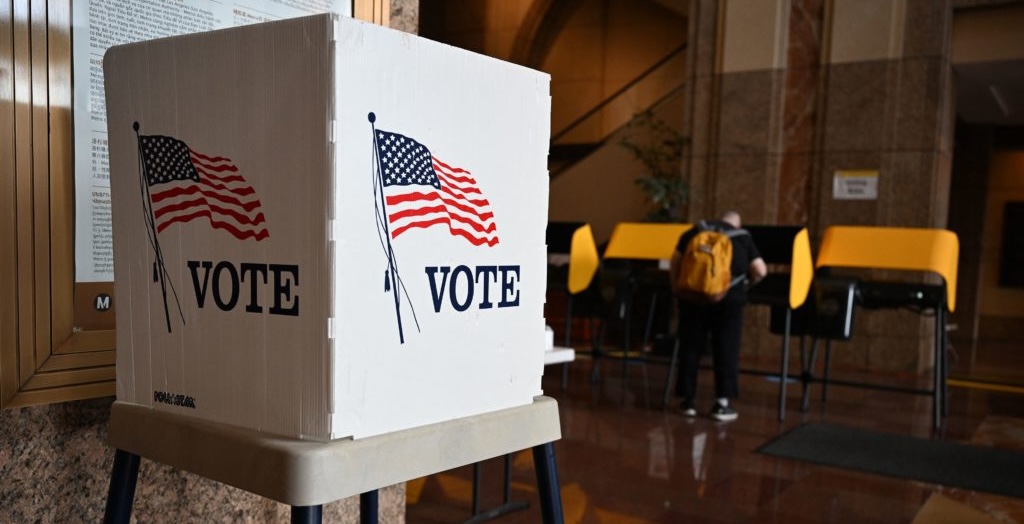

With early voting underway across the country, the vote that’s in so far is showing higher turnout than in recent midterms, even as Republican turnout is depressed. The early numbers are backing up signals from polling that indicate that a blue wave might be imminent but that a lot of elections will probably be close.
After polls and special elections, early voting serves as a leading indicator of what might happen on Election Day. Data is starting to roll in from every critical state in the 2026 midterms, except Alaska, which has yet to report its data.
Michael MacDonald, a professor of political science at the University of Florida, runs the leading resource on early voting at the University of Florida Election Lab. The lab provides a state-by-state breakdown of early voting information down to precincts and by partisan affiliation and demographic, at least for states that collect that information.
In an interview with The Caucus, MacDonald cautioned that it’s still early in the voting process, meaning early voting data isn’t as predictive or reliable as it is closer to Election Day, but that there are still trends emerging that could prove decisive in the midterms.
“So far we're seeing robust turnout in states where we've started in-person early voting. We're seeing levels that are above 2018 and 2022,” MacDonald said. “Right now the numbers generally across the board are higher than they were in the last two [midterm] elections.”
In North Carolina, for example, there have already been some 730,000 votes cast, about 19% more than had been cast at this point in the 2022 midterms. The partisan breakdown of the votes cast so far also skews heavily towards Democrats in the state, with 45% of the early vote being cast by registered Democrats and 21% being cast by registered Republicans, with the remainder being cast by unaffiliated or minor party voters.
While it's been a trend in recent elections that Democrats are more likely to vote early and by mail, MacDonald said that overall, Republican participation in the midterm is lower than expected at these turnout levels, and some demographics of Republicans are actually turning out at lower rates than in comparable recent elections.
“When I look at party registration, I'm seeing higher engagement levels among Democrats and by unaffiliateds, and I'm seeing, with a couple exceptions, lower participation among registered Republicans,” MacDonald said. “In fact, you can see in some states like North Carolina, where turnout is up for just about every group, but actually compared to 2022 and 2018, turnout is down for white Republicans in the state. So there's clearly something going on in North Carolina, and you're seeing similar patterns elsewhere.”
While turnout is depressed among white Republicans in some areas, turnout is up among Hispanic voters and, to a lesser degree, Black Americans, at least in states that collect this data. If these trends end up carrying across state lines, it could mean that Democrats are set to overperform in heavily Hispanic parts of the country like south Texas, though MacDonald cautioned that it's still too early to draw anything but preliminary observations.
At the same time, MacDonald said, there is plenty of data to suggest that Republicans are still competitive in many swing districts and in other races where polling has suggested a tight race, like in Maine, Iowa and in several of the competitive districts in Pennsylvania.
The last trend MacDonald has identified from the data so far is that voting by mail has declined in 2026, a trend which he attributes to the end of the pandemic and fears that the mail in vote could be more susceptible to interference from the Trump administration.